
Home›Insurance record
Your home inventory, ready for your insurer.
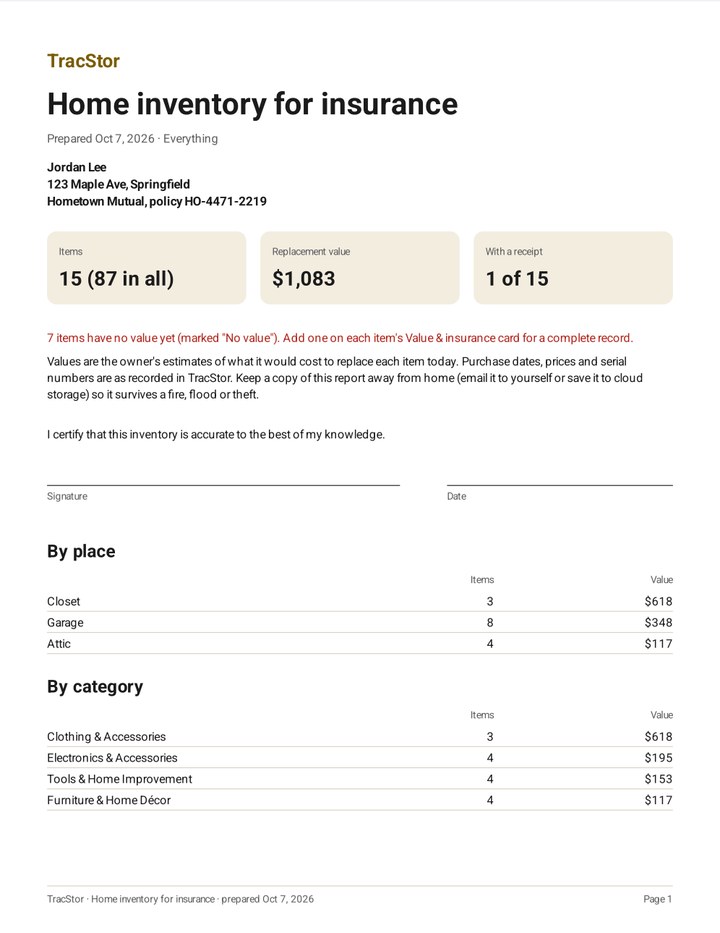
After a fire, flood or break-in, the first hard question is “what did you have?” TracStor already knows what's in every bin, closet and storage unit. Add what things are worth and a photo of the receipt, and it makes one PDF you can hand to your insurer.
In the app today. Made on your phone; nothing is uploaded.
Insurance›Why it matters
Most homes have no inventory. Insurers still ask for one.
“Your inventory will help you prove the value of what you owned.”
FEMA, Document and Insure Your Property
Insurance›What goes in it
What insurers ask for, and where TracStor keeps it
Insurers and regulators recommend recording the same handful of details for each item.6, 7 TracStor has a place for every one of them.
| They ask for | In TracStor |
|---|---|
| A description and photos | Each item's name, notes and photos, plus photos of the bin and what's in it |
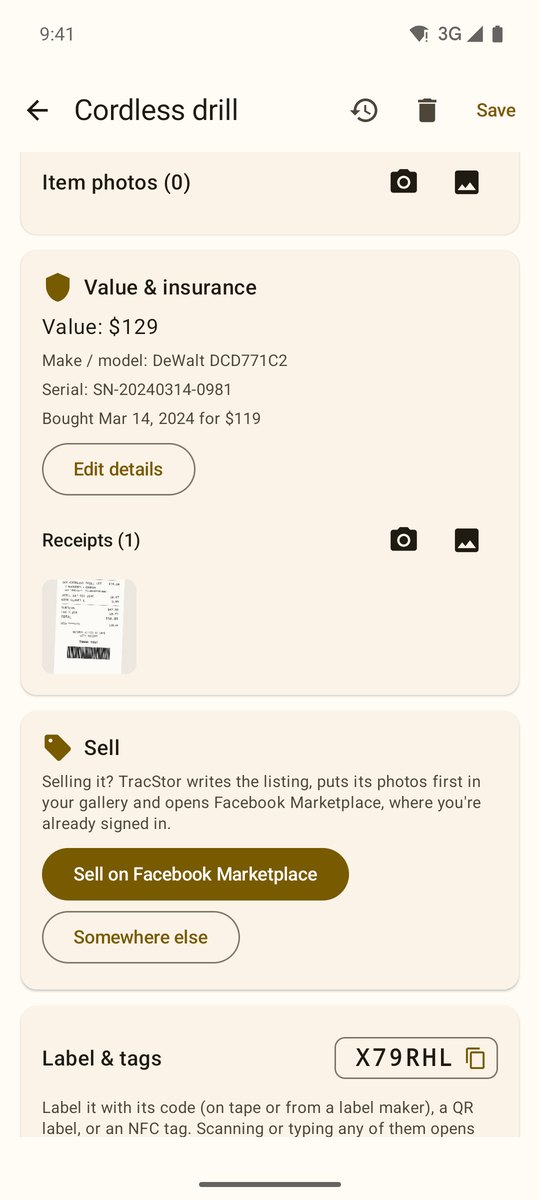
| Make, model and serial number | The item's Value & insurance card |
| When and where it was bought, and the price | Purchase date and price on the same card |
| What it's worth today | Replacement value, each; the report multiplies by how many you have and totals it |
| Receipts, invoices, appraisals | Receipt photos on the item; each one printed full size at the end of the report |
| Things in the basement, attic, garage and storage unit | That's where TracStor lives: every item listed by place and bin, down to the stack |
| A copy kept away from home | Save the PDF to Google Drive or email it to yourself; the full backup ZIP goes anywhere you choose |
Insurance›The report
One PDF: totals, every item, every receipt
Real pages from a report made in TracStor. Your name, address, insurance company and policy number go on the cover if you add them.
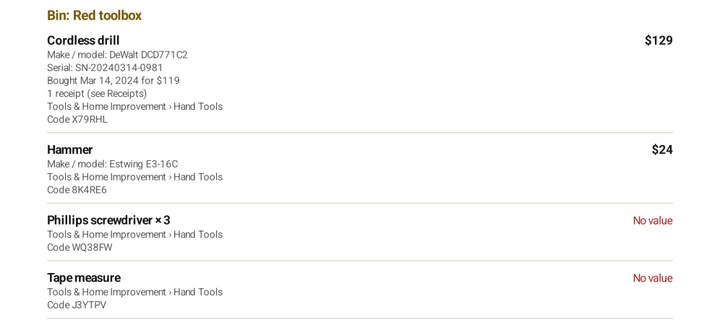
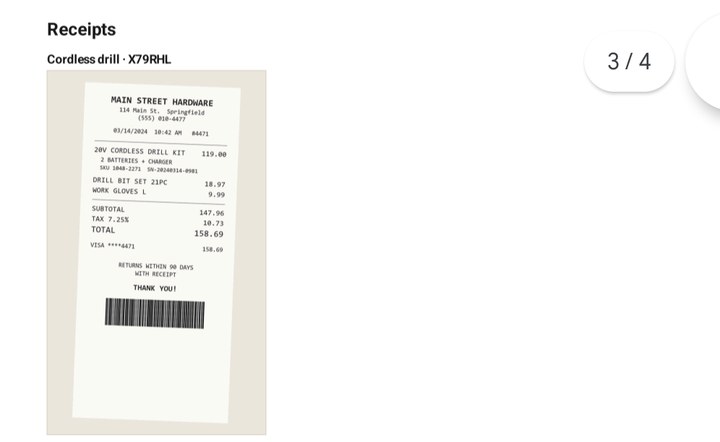
Sample data. The receipt is from a made-up store.
Insurance›How
Three steps, as you go
- Add values while you're there. Open an item, tap Value & insurance, and enter what it would cost to replace, plus make, model and serial number if it has them. Start with the expensive things: TVs, tools, bikes, cameras, instruments.
- Photograph the receipt. The camera button on the same card. Paper receipts fade; photos don't.
- Make the PDF. Settings › Insurance & inventory report. Everything, or one place: just the garage, just the storage unit. Save it to Google Drive or email it to yourself.
Keep it current: after big purchases, and each season. California's insurance department suggests updating an inventory three or four times a year.8
Insurance›Private
A list of everything valuable you own shouldn't live on someone else's server.
TracStor keeps your inventory on your phone. There's no account, and the report is made on the phone itself. It goes only where you send it.
- Account
- None needed.
- Report
- Made on your phone, saved where you choose.
- Copy away from home
- Google Drive, email or a computer: your choice.
- Spreadsheet
- The backup's items.csv includes values, serial numbers and purchase details.
Insurance›FAQ
Questions
Will my insurance company accept it?
The report records what insurers and regulators recommend: descriptions, photos, make, model, serial numbers, purchase details, values and receipts. Each insurer decides what it needs for a claim, so check your policy or ask your agent. TracStor doesn't file claims or talk to insurers for you.
Do I have to enter a value for everything?
No. The report lists everything, and items without a value say “No value” in red, with a count on the cover. Start with the expensive things and fill in the rest over time.
I rent. Is this for me too?
Yes. Renters insurance covers your belongings the same way, and the report is the same.
Can I make a report for just one place?
Yes: choose a place when you create the report, for example the garage or a storage unit. Its areas and sub-places are included.
Is anything uploaded?
No. TracStor has no account and no servers holding your inventory. The PDF is made on your phone and goes where you save or send it.
What does it cost?
TracStor is free during early access, including the report.
Start the list before you need it
TracStor is in early access on Android. Join early access · How-to guide · How TracStor compares
Sources
- Insurance Information Institute (Triple-I) and Munich Re, homeowners' perception of weather risks, survey of 2,018 US adults (1,103 homeowners), 2023: 47% have an inventory. iii.org.
- Triple-I, Facts + Statistics: Homeowners and renters insurance (ISO/Verisk data, 2019–2023): about 1 in 18 insured homes has a claim each year; average theft claim $5,524. iii.org.
- United Policyholders, 2025 Los Angeles wildfires six-month survey (453 households, July–September 2025; survivors who chose to respond, not a national sample). uphelp.org.
- Triple-I, What is covered by standard homeowners policies: coverage for belongings is generally 50 to 70% of the coverage on the house. iii.org.
- FEMA, Document and Insure Your Property (FEMA P-1097), via Ready.gov. ready.gov.
- Triple-I, How to create a home inventory. iii.org.
- State Farm, Home inventory: how to create one (includes items in basements, attics, garages and self-storage units). statefarm.com.
- California Department of Insurance, Home Inventory Guide (June 2023). insurance.ca.gov.
TracStor isn't affiliated with any insurer or organization named here. Checked October 7, 2026.